
On the evening of 24 April 2026, the AAU and Lakeside Park hosted the largest Long Night of Research ever held in Carinthia: 106 stations, one campus, and approximately 9,000 visitors recorded throughout the night. NES contributed with a strong presence across three stations, spanning swarm robotics, wireless sensing, and the intersection of nature-inspired principles with modern technology.
Swarm Intelligence in the Air
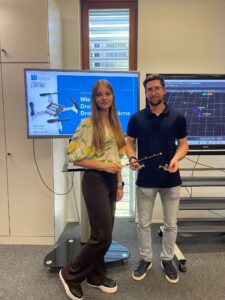
The central research question at this station was: How do individual drones and multi-agent swarms navigate complex environments? Using a motion-tracked wand, visitors could pilot one or two drones simultaneously, with a trajectory-matching algorithm evaluating their spatial accuracy in real time. Two further maneuvers illustrated core research concepts: an autonomous collision avoidance demonstration involving three concurrently flying drones, underpinned by the Voronoi algorithm, and a synchronized figure-8 formation flight showcasing multi-agent coordination principles.
Can Your Wi-Fi Detect Intruders?
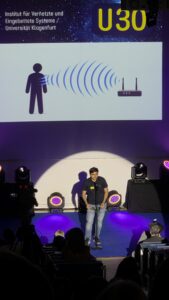
This station presented a real-time demonstrator capable of detecting the presence of people in a room and estimating their number using Wi-Fi signals alone, without any camera-based sensing. The system offers a privacy-preserving alternative to video surveillance, with lower deployment costs and straightforward scalability based on existing wireless infrastructure.
What Happens When Nature and Technology Learn from Each Other?
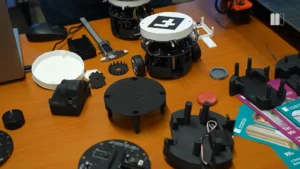
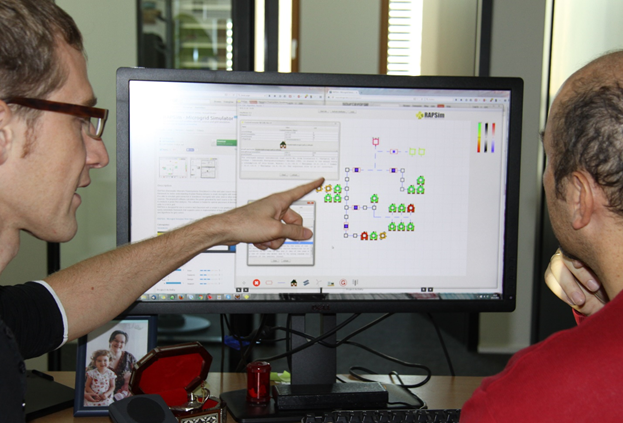
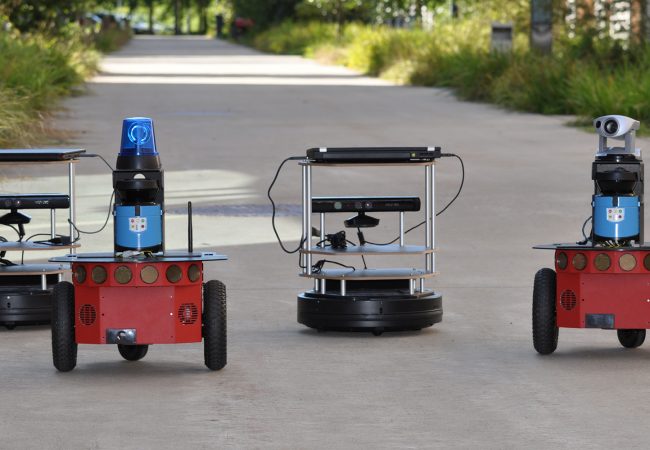
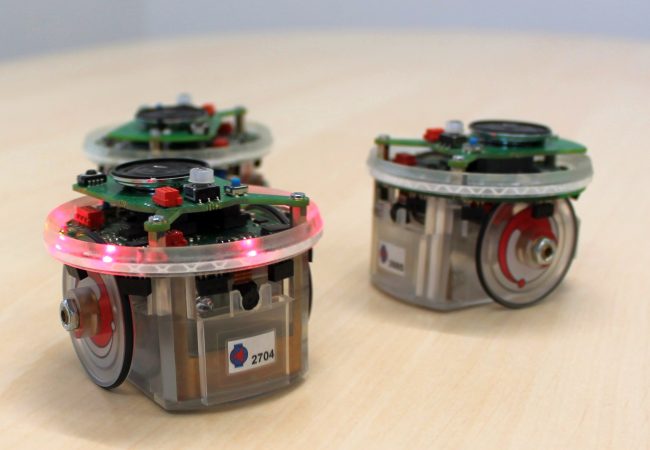
The Smart Grids group presented a selection of current research projects, alongside practical prototyping and third mission activities. The Digital Energy Sandbox Carinthia is a simulation platform linking e-mobility, sustainable energy, charging infrastructure, and the power grid in a single system, addressing questions around simultaneous EV charging, smart charging station placement, and vehicle swarm coordination to support rather than strain the grid. The group also presented work on self-organising power networks inspired by slime mould, translating the organism’s ability to form efficient, adaptive networks without central control into computer models for smarter energy grid design. The robotics side featured a live demonstration and technical dissection of the (swarm) robot platforms Spiderino and Mechalino, used across teaching and research. Visitors could also try Electric Alps, a logic-based wiring puzzle game, explore 3D printing applications in research and hardware prototyping, and engage with serious games on topics such as future mobility and invasive species management.
Cover image: © Lange Nacht der Forschung (#LNF26), langenachtderforschung.at
Photos: NES, AAU

Recent Comments