
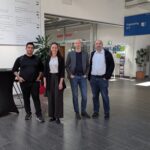
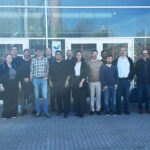
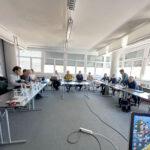
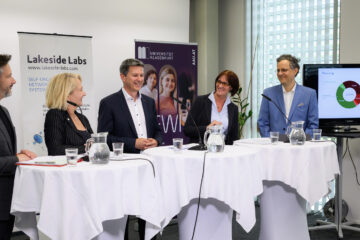
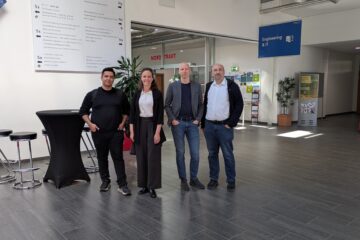
On 7 April 2026, the Shared Charging project consortium convened for an internal workshop on inclusive and user-centred design, hosted by FH Kärnten at its Villach campus. Representatives from nine partner organisations attended: FH Kärnten, AAU, Lakeside Labs, go-e, Kelag, Silicon Austria Labs, Silicon Alps, Infineon, and Kärnten Solar, covering the full breadth of the project’s research and development activities.
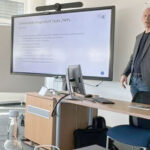
Each partner presented their respective work across three dimensions: system-level concepts, user interaction and access approaches spanning hardware, software, and app solutions, and the key assumptions and constraints shaping usability and accessibility.
The workshop centred on four interconnected areas. Discussion on personas and user modelling focused on moving towards more evidence-based representations of EV users, including future user groups not yet owning electric vehicles. Planned additions include company-car scenarios and more statistically robust profiling methods. On survey design and data collection, partners aligned on capturing charging behaviour, mobility patterns, socio-economic factors, and accessibility needs, with particular attention to data privacy and the coordination of questions across the consortium.
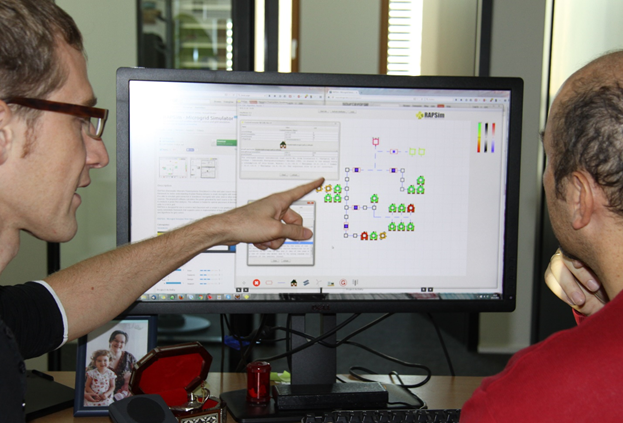
AAU contributes to the project through its Digital Energy Sandbox, a co-simulation framework into which user acceptance rates and criteria derived from the project’s user research are directly fed. This allows the Sandbox to model not only the technical infrastructure but also its influence on mobility patterns and charging behaviour, providing the consortium with a more complete picture of how deployment decisions translate into real-world outcomes.
Regarding use cases, the group refined scenarios around commuters (including shift workers) and shopping-trip charging, acknowledging the role that available charging infrastructure plays in shaping user behaviour itself. Finally, the team advanced work on charging logic and UX/accessibility, discussing intelligent energy prioritisation models that balance user need, PV availability, grid load, and cost, alongside ergonomic cable-handling assessments planned with vulnerable user groups.
The workshop marked a productive step in grounding the Shared Charging project’s technical development in real user needs, and sets the stage for an upcoming evidence-based survey to validate and refine these findings. The Shared Charging Project is funded by Austria’s Climate and Energy Fund (FFG Zero Emission Mobility+) and runs from January 2025 to December 2028.



Recent Comments